
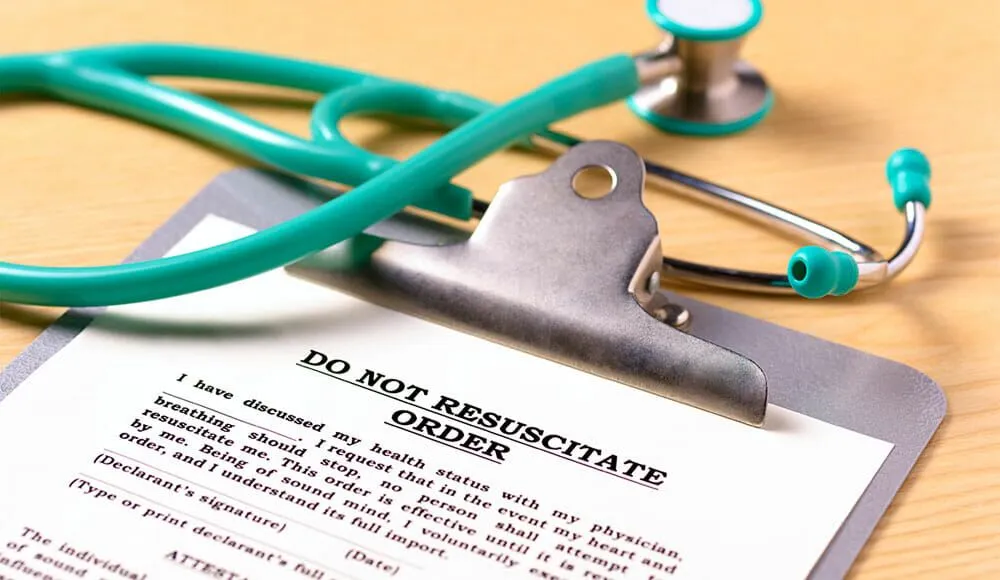
A do not resuscitate order, commonly called a DNR, tells health care professionals not to attempt cardiopulmonary resuscitation when a patient’s breathing or heartbeat stops. DNR laws are not uniform across the United States. State rules, medical-order requirements, care setting, and the patient’s capacity can all affect how an instruction is created and honored.
A DNR also has a narrower purpose than many people assume.
What Does a DNR Actually Cover?
A DNR generally addresses resuscitation after cardiac or respiratory arrest. It does not automatically mean that a person refuses antibiotics, pain control, nutrition, hospitalization, surgery, or every other form of treatment.
The National Institute on Aging describes a DNR as a medical-chart order telling health care staff not to perform CPR or related life-support procedures if breathing or heartbeat stops. It distinguishes DNR orders from other instructions such as DNI and out-of-hospital DNR orders.
A Medical Order Is Different From a Living Will
A living will expresses preferences, while a DNR is generally entered as a medical order under applicable rules. Someone researching end-of-life terminology may encounter online topic collections as part of broader reading, but state health departments and treating clinicians are more relevant when determining the required DNR form.
Who Can Request or Authorize a DNR?
A patient with decision-making capacity can generally participate directly in decisions about resuscitation. If the patient lacks capacity, applicable state law and existing documents may determine whether an authorized surrogate, health care agent, guardian, or other representative may participate.
Federal hospital rules recognize a patient’s right to make informed decisions and, where state law allows, permit a representative to exercise that role. They also recognize the right to request or refuse treatment.
Readers may also see professional information directories while researching these issues. Such sources do not establish who has legal authority in an individual case; that question depends on governing law and the patient’s documents.
| Instruction | Primary Purpose | Typical Setting Issue |
|---|---|---|
| DNR | No CPR after arrest | Must be recognized as a medical order |
| DNI | No intubation | May be separate from DNR |
| Living will | Records treatment wishes | Activates under defined circumstances |
| Portable medical order | Communicates current orders | Form and name vary by state |
Why Setting and Documentation Matter
A hospital DNR may not function the same way outside the hospital. Emergency medical services often operate under state-specific rules concerning recognizable out-of-hospital DNR, POLST, MOLST, or similar portable medical-order forms.
NIA guidance specifically notes that an out-of-hospital DNR can alert emergency personnel and that portable medical-order systems vary by state.
General public-interest news resources can provide broad reading, but emergency personnel must follow the legally recognized orders and protocols applicable where care occurs.
Common Assumptions That Cause Confusion
The biggest misconception is that DNR means “do not treat.” It does not necessarily stop ordinary medical care before an arrest. The patient’s other choices remain relevant.
Families may also assume that a relative can simply announce a DNR without legal authority or proper medical documentation. In many settings, verbal wishes must be translated into a recognized medical order. Another source of confusion is keeping paperwork where emergency personnel cannot find it. A valid order that is unavailable during an emergency may not accomplish its intended purpose.
When Should Legal or Clinical Help Be Sought?
Prompt help is appropriate when relatives disagree about resuscitation, an existing DNR appears inconsistent with the patient’s current wishes, staff question whether a surrogate has authority, or a transfer between facilities creates uncertainty about whether the order remains effective.
Contact the treating physician or facility immediately when the issue affects current care. State-specific legal advice may also be needed for guardianship, disputed capacity, conflicting documents, or allegations that an authorized instruction is being disregarded.
Frequently Asked Questions
Does a DNR prevent all medical treatment?
No. A DNR generally concerns attempts to restart breathing or circulation after arrest. Other treatment decisions must be addressed separately according to the patient’s wishes, clinical circumstances, and applicable orders.
Is a living will the same as a DNR?
No. A living will is an advance directive describing treatment preferences. A DNR is generally a medical order focused specifically on resuscitation.
Does a DNR travel with a patient?
Not necessarily in the same form. Recognition outside a facility can depend on state rules and whether the patient has the required portable or out-of-hospital medical order.
Make the Instruction Clear Before It Is Needed
A DNR is most useful when the patient understands its scope, the correct state-recognized documentation is completed, and family members and care teams know where to find it. Discussing the decision before a crisis also helps distinguish resuscitation preferences from other treatment choices.
The legal form matters, but so does making sure the order can actually be recognized where care occurs.
This article provides general legal information and is not a substitute for advice from a qualified attorney regarding a specific situation.