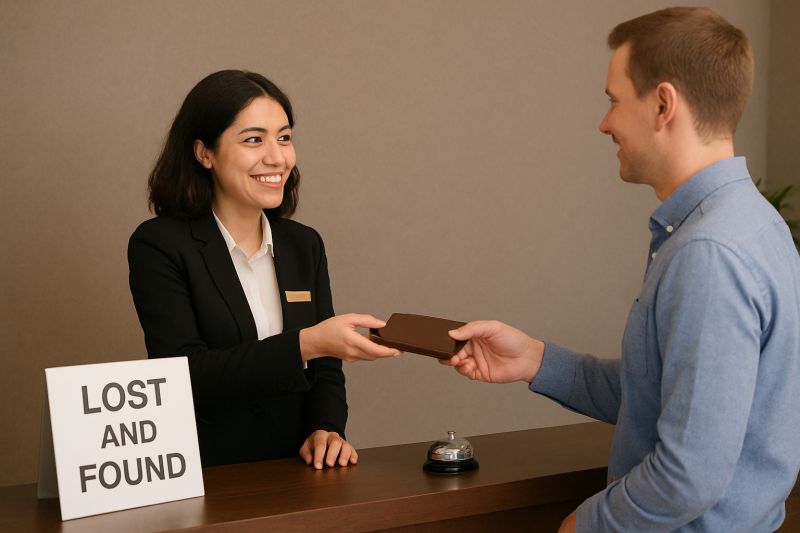
A phone left beneath a pillow, jewelry discovered in a safe, or luggage forgotten in a lobby can create legal and operational questions for both guests and hotels. Hotel lost property laws are not governed by one nationwide retention period. State statutes, local rules, common-law property principles, and hotel procedures can all matter.
The safest assumption is that an item does not become hotel property merely because a guest left it behind.
Who Owns Property Left at a Hotel?
The original owner generally retains important rights in property that was accidentally lost or mislaid. Cornell’s Legal Information Institute explains that many jurisdictions have modified older common-law lost-property rules through statutes governing how found property must be handled.
Exactly who has possession rights, how an item must be reported, and when ownership can change depend on the jurisdiction.
People searching online may move between statutes and general reference reading, but a hotel’s location is important because one state’s found-property requirements can differ from another’s.
Lost, Mislaid and Intentionally Abandoned Property
These categories can produce different results. A wallet apparently dropped in a hallway is not necessarily treated the same as an object deliberately discarded in a trash container.
Hotel employees should be cautious about assuming abandonment. Context, housekeeping practices, guest communications, and applicable law may all affect the classification.
What Should Hotels Do With Found Items?
A sensible lost-property procedure normally records what was found, where it was discovered, when it was recovered, and who took custody. Valuable items may require stronger storage controls than ordinary clothing or inexpensive toiletries.
Once a hotel knowingly accepts an item for safekeeping, concepts associated with bailment may become relevant. A bailment involves temporary possession of another person’s property without transferring ownership.
Hospitality operators reviewing business-focused web material should still base retention and disposal practices on the law where the property operates rather than copying another hotel’s policy.
| Found Item | Practical Handling | Key Concern |
|---|---|---|
| Identification | Secure and record promptly | Identity misuse |
| Electronics | Store with access controls | Data and ownership |
| Cash or jewelry | Document carefully | Custody disputes |
| Clothing | Follow retention policy | Storage and disposal |
Notice, Collection and Return Arrangements
Hotels may attempt to contact an identifiable owner, particularly where reservation records make identification practical. The legal extent of that obligation depends on applicable law.
Return shipping also raises practical questions. A hotel and guest may agree on a delivery method, courier charge, or collection arrangement without changing ownership of the item.
Someone comparing policies through general financial and business reading should remember that a hotel’s written policy cannot necessarily override a statute requiring specific treatment of found property.
Why a Retention Period Shouldn’t Be Guessed
A common mistake is claiming that every U.S. hotel must keep lost property for 30, 60, or 90 days. No single nationwide hotel rule creates one universal period.
Some jurisdictions impose reporting, holding, or transfer requirements for certain found property. Others rely more heavily on general property law. Valuable items, identification documents, firearms, medications, or suspected illegal property can also require different handling.
When Does a Lost-Property Dispute Need Formal Help?
Legal advice may be useful when a high-value item disappears after staff acknowledge receiving it, ownership is contested, an item is disposed of despite timely notice, or there are allegations of employee theft.
Suspected crimes should be reported through appropriate law-enforcement channels. Both sides should preserve claim numbers, emails, receipts, photographs, shipping records, and the hotel’s lost-and-found documentation.
Frequently Asked Questions
How long must a hotel keep property left in a room?
There is no universal U.S. retention period applying to every hotel. The answer can depend on state or local law, the type and value of property, and any lawful hotel retention policy.
Can hotel staff keep an unclaimed item?
Employees should not assume an unclaimed object automatically belongs to the finder. Statutes in many jurisdictions modify common-law finder rules and may require holding, reporting, transferring, or otherwise processing the property first.
Is a hotel automatically liable for anything a guest loses?
No. Liability depends on how the loss occurred, whether the hotel took possession, applicable innkeeper statutes, negligence principles, posted limitations that comply with law, and other facts specific to the jurisdiction.
Use a Documented Process From Discovery to Disposal
Strong lost-property procedures create a traceable chain from discovery through return, lawful transfer, or disposal. That protects guests while reducing disputes about what staff received and what happened afterward.
Because hotel lost property laws differ across jurisdictions, hotels should confirm local requirements rather than adopting an arbitrary retention period from another property.
This article provides general legal information and is not a substitute for advice from a qualified attorney regarding a specific situation.